Home Design Patterns Object Pool
Object Pool
Modern PracticeKeep a set of ready-made objects and lend them out one at a time, instead of creating and destroying one per use.
Purpose
Some objects are expensive to come by. A database connection costs a TCP handshake, a TLS negotiation, an authentication round trip and, on PostgreSQL, a forked backend process on the server. A thread costs a stack and a kernel object. A DMA capture buffer costs pinned physical memory that has to be reserved before the system is doing anything useful. Creating one of those per request and throwing it away is not a small waste, it is usually the dominant cost of the request.
A pool keeps a supply of them already made. A caller acquires one, uses it exclusively, and releases it back. The borrower gets no say in construction and does not destroy the object when finished; it hands it back for the next borrower. The second half of that sentence is the entire pattern and the entire difficulty, because nothing in most languages will make a borrower give anything back.
Design
A pool holds a free list and, usually, a record of what is currently lent out.
acquire takes an object off the free list, or creates one if the pool
is below its maximum size, or waits, or fails, and that policy choice is the most
consequential decision in the whole implementation.
release resets the object and puts it back.
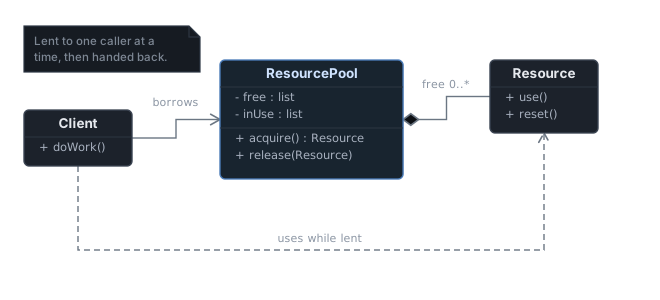
Reset is where pools get dangerous. The object coming back carries whatever the last borrower did to it: an open transaction, a changed timeout, a cached result, a session variable. Either the pool scrubs it on release or every borrower must not care, and "must not care" is not a property you can enforce or even easily test. Add a field to the pooled class two years later and the reset routine will not know about it.
Validation on the way out matters for anything with a peer at the other end. A pooled connection can be perfectly valid in your process and long since closed by the server or a firewall idle timer, so a pool that hands out connections without checking them turns an infrastructure timeout into a random application error somewhere far away.
Example
The Autobot Robotics office-side reporting service builds shift summaries by
querying a PostgreSQL database that holds job history for every cell a customer
runs. The original code opened a connection per report and closed it at the end,
which is the correct instinct and was fine while there were a dozen cells. The
overnight run for a large customer opens several thousand of them. Connection
setup dominated the run time, and worse, PostgreSQL runs a separate backend
process per connection and enforces a hard max_connections, so the
reporting job was periodically pushing the server to its limit and causing
connection failures in the unrelated ERP that shares that database. The cost of
the pattern's absence was not slowness, it was an outage in something else.
A connection pool with a fixed maximum fixed both problems at once, because a pool is also a limiter: the reporting service now cannot open more than its share no matter how many reports are queued. Reports queue instead of the database failing, which is the correct way for a system to behave under overload.
The vision system pools for a different reason entirely. It reserves its
camera capture buffers at start-up, because they must be physically contiguous and
page-locked for the capture hardware to write into, and asking the operating
system for one of those while a part is moving down the line is not something you
can rely on. There the pool is not an optimization, it is how you guarantee the
resource exists at all. Someone later tried pooling the plain
Report objects on the office side by the same reasoning, and it was
slower than allocating them, plus it produced a bug where a report showed the
previous customer's site name because one field was missed in the reset.
class ConnectionPool
{
    private readonly Stack<DbConnection> free;
    private int lent;
    private readonly int max;

    public DbConnection acquire()
    {
        // Hand back a live one, make a new one, or make the caller wait.
        // Which of the three is the only interesting decision here.
        if (free.Count > 0)
        {
            DbConnection c = free.Pop();
            if (!c.isAlive()) { c.destroy(); return openNew(); }
            lent = lent + 1;
            return c;
        }
        if (lent < max) { lent = lent + 1; return openNew(); }
        return waitForRelease();
    }

    public void release(DbConnection c)
    {
        c.rollbackIfOpen();     // scrub the previous borrower's state
        c.resetSessionVars();
        lent = lent - 1;
        free.Push(c);
    }
}

class ShiftReport
{
    private readonly ConnectionPool pool;

    public void build(int cellId)
    {
        DbConnection c = pool.acquire();
        try
        {
            // run the queries, assemble the summary
        }
        finally
        {
            pool.release(c);    // the one line the whole pattern depends on
        }
    }
}release is in a finally block.
A pool where a borrower can return early, throw, or simply forget is a pool
that starves, and the language will not warn you.Seen in the Wild
Connection pooling is the most-deployed instance of this pattern in existence:
.NET's SqlClient pools connections by default, HikariCP and Apache
Commons Pool do the same job in Java, and PgBouncer sits outside the application
entirely and pools PostgreSQL connections for everything that talks to it. Thread
pools are the other big one, with the .NET ThreadPool and Java's
ThreadPoolExecutor both existing because creating a thread per task
does not scale. .NET's ArrayPool<T> and Netty's
PooledByteBufAllocator pool buffers specifically to keep large
short-lived allocations away from the garbage collector. Go's
http.Transport keeps a pool of keep-alive connections per host, which
is why an idle HTTP client in Go is holding sockets.
Comparisons
- Flyweight is the one to get straight, because the two are constantly confused. A pool lends an object exclusively and takes it back; a flyweight is shared by everybody at once and is never returned, because it was never borrowed. A pooled object is mutable and gets reset between users; a flyweight is immutable precisely so it can be used simultaneously. A pool exists to avoid the cost of construction, a flyweight to avoid the cost of duplication. If two callers can hold it at the same time it is a flyweight, and if one caller must give it back it is a pool.
- Singleton is how the pool itself is usually reached, and it inherits every one of Singleton's problems when done that way. Inject the pool instead; there is no reason a test should share the production one.
- Proxy is the standard trick for making release
automatic: hand out a wrapper whose
closereturns the object to the pool rather than destroying it, which is exactly what pooled JDBC and ADO.NET connections do. It is also why callingCloseon a pooled connection is cheap and correct rather than wasteful. - Multiton keeps one instance per key permanently. A pool keeps many interchangeable instances and cares which are free, not which is which.
- Lazy Load describes the growth policy a pool usually adopts: create nothing at start-up, create on first demand, up to a ceiling.
Why It Exists
My take
Object Pool exists because some costs are not yours to reduce. You cannot make a TLS handshake cheaper, or make PostgreSQL fork a backend faster, or make the operating system produce a page-locked buffer on demand while a conveyor is moving. When the expensive part happens outside your process, the only lever left is to do it fewer times, and a pool is that lever. Read that way the pattern is not about objects at all; it is about the lifetime of something scarce that an object happens to represent.
Which is why I think pooling ordinary objects is usually a mistake today. A
generational collector allocates by bumping a pointer and collects short-lived
garbage almost for free, so replacing that with a synchronized free list buys
you lock contention, a reset routine that will eventually miss a field, and the
chance of a leak, in exchange for saving an allocation that was already nearly
free. Every time I have seen a pool of plain application objects it was slower
than not having one, and the Report objects in the example above
are a real instance of that. Measure before pooling anything that is only
expensive in your imagination.
The cases where it stays right are the ones where the resource is genuinely
scarce rather than merely expensive: connections against a fixed server limit,
threads, file handles, sockets, hardware buffers, device handles. And it is
right in embedded and real-time work for a reason that has nothing to do with
speed. In a system with no garbage collector where allocation failure is not an
acceptable outcome, you allocate everything at start-up and hand it out from
fixed pools, so that memory exhaustion is something you prove cannot happen
rather than something you handle. The kernel work I did was built that way
throughout. There is no free list because free lists are fast; there is a free
list because malloc at run time is banned.
The other thing worth saying is that a pool with a maximum is a rate limiter that people build by accident and then depend on. That is a real benefit and deserves to be a deliberate one. Bounding the pool converts an unbounded fan-out into a queue, and a queue is a system behavior you can reason about, while an unbounded fan-out is an outage waiting for enough traffic.
Criticisms
The pattern reintroduces manual memory management on top of a runtime that
was built to remove it, and it does so without any of the tooling. A borrower
that forgets to release leaks a pooled object, and the symptom is not a crash but
a hang: some time later, under load, every caller blocks in acquire
forever. That is harder to diagnose than a memory leak and it only appears when
the system is busy, which is to say in production. Languages help a little here
(using and try-with-resources exist for exactly this)
but nothing prevents a reference from escaping the block and being used after it
was returned, which is a use-after-free with extra steps.
State leakage between borrowers is the other recurring bug and it is worse than it sounds, because the failures are silent and correlated with what someone else did. A pooled object that keeps a customer identifier, a transaction, a locale or a cached row hands that to the next user. In a multi-tenant system that is a data disclosure bug, and it is created by adding a field to a class, which is not a change anybody thinks to review against a reset routine in a different file.
Finally, pool sizing is guesswork that is invisible until it is not. Too small and everything queues behind the pool while the resource sits idle; too large and you have simply moved the overload downstream to the thing you were trying to protect, which now falls over with a more confusing error. There is no correct static answer, since it depends on concurrency, hold time and what else shares the resource, and every default value shipped in every pooling library is a guess that was right for somebody else's workload.