Home Design Patterns Arena
Arena
Ownership and LifetimesAllocate many objects with one lifetime, and release them all at once.
Purpose
An arena owns a block of storage and hands out slots in it. Individual objects are never freed. When the arena drops, everything inside it goes at the same instant.
The obvious payoff is speed. Allocation becomes a pointer bump instead of a walk through a free list, and teardown becomes one operation instead of ten thousand. The less obvious payoff, and the reason arenas show up constantly in Rust specifically, is that an arena dissolves an ownership problem. Ownership in Rust is a tree: every value has exactly one owner. Real data structures are frequently graphs, with cycles and back-references and nodes pointed at from several directions. Those two facts are in direct conflict, and the arena is how you resolve it without reaching for reference counting.
Design
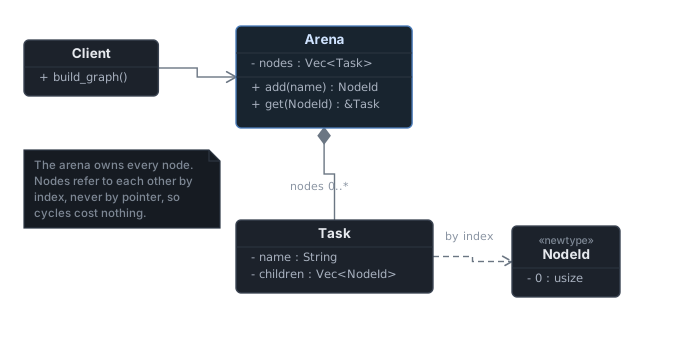
The arena holds a growable vector of nodes. Adding a node returns a handle, typically an index wrapped in a Newtype so it cannot be confused with any other integer in the program. Nodes refer to each other by handle rather than by reference.
That indirection is the whole trick. A cycle between two nodes is now just two integers pointing at each other, which the borrow checker has no opinion about whatsoever. The arena is the single owner; everything else holds what is effectively a private pointer that the compiler does not have to reason about.
There is a second flavor worth knowing. A typed arena hands back a genuine reference tied to the arena's lifetime, so nodes point at each other directly and no index lookup is needed. It is more ergonomic to read and harder to use, because every type that touches a node now carries a lifetime parameter, and that parameter is contagious.
Example
Autobot Robotics' task scheduler needs a dependency graph. A production run is a set of tasks where one cannot start until others have finished, and the same subtask legitimately appears as a prerequisite of several others. Drilling must precede inspection; cleanup follows both; a fixture change is a prerequisite of everything downstream of it.
In the C# scheduler this was a straightforward object graph, because a garbage collector will happily let two objects point at each other forever. The first attempt at porting it kept that shape and immediately hit the wall every Rust newcomer hits: a parent owns its children, a child needs to see its parent, and there is no way to write that without reference counting, weak pointers, and a runtime borrow check on every access.
The arena version deleted all of that. One vector owns every task, tasks
name each other by TaskId, and the whole graph is freed when the
run completes by dropping a single value.
#[derive(Copy, Clone, PartialEq)]
struct TaskId(usize);

struct Task {
    name: String,
    children: Vec<TaskId>,
}

struct Arena {
    nodes: Vec<Task>,
}

impl Arena {
    fn new() -> Arena {
        Arena { nodes: Vec::new() }
    }

    fn add(&mut self, name: &str) -> TaskId {
        let id = TaskId(self.nodes.len());
        self.nodes.push(Task {
            name: name.to_string(),
            children: Vec::new(),
        });
        id
    }

    fn add_child(&mut self, parent: TaskId, child: TaskId) {
        self.nodes[parent.0].children.push(child);
    }

    fn get(&self, id: TaskId) -> &Task {
        &self.nodes[id.0]
    }
}nodes owns everything, and
children holds handles rather than references. Note that
add_child can link two tasks in either direction without any
ownership question arising.Seen in the Wild
The Rust compiler allocates its own syntax trees and type structures into
arenas, which is why so much of rustc's internal API carries an
explicit lifetime. The bumpalo, typed-arena and
slotmap crates are the common off-the-shelf implementations, and
petgraph represents graphs by index for exactly the reason
described above. Outside Rust the idea is much older: Apache and nginx both
allocate per-request memory pools and release them wholesale when the request
finishes, and region-based allocation has been standard practice in compilers
and game engines for decades.
Comparisons
- Object Pool is the pattern arenas are most often confused with. A pool hands out one object and takes it back for reuse; an arena hands out many and takes none of them back until the end. Pools manage reuse, arenas manage lifetime.
- Composite is what you are usually building inside an arena. In a garbage-collected language a Composite is just references; in Rust an arena is the normal way to express one.
- Flyweight also reduces allocation, but by sharing identical state between objects rather than by grouping unrelated objects under a common lifetime.
- Interior Mutability is the
alternative answer to the same ownership problem, and the worse one. Reach for
an arena before reaching for
Rc<RefCell<T>>. - Newtype is what stops an arena handle being an
ordinary
usizethat can be passed anywhere.
Why It Exists
My take
Arena exists because individual object lifetime is usually a fiction we maintain at considerable expense. Most objects in a program do not have meaningful independent lifespans. They are born during some phase of work and they die when that phase ends, all together. Tracking each one separately, by refcount or by garbage collector or by hand, is paying a per-object price for information the program never actually used.
The Rust angle is more specific and more interesting. Rust's ownership model is a tree, and a tree cannot express a graph. Rather than weaken the model, arenas change the question: instead of asking who owns this node, you declare that the arena owns all of them and everything else holds an index. What looks like a memory optimization is really a modeling decision, and the performance win is a side effect.
This one lands close to home for me. On the embedded controller I could not
afford a general-purpose allocator at all, because a free() that
might walk a heap has no bound on how long it takes, and an unbounded pause is
the one thing a real-time system cannot tolerate. What we did instead, without
ever calling it a pattern, was carve out a region per machine cycle and reset
the pointer at the end of the cycle. That is an arena. Finding out years later
that the technique has a name and a literature was mildly annoying.
Criticisms
Handles are not references, and the compiler stops helping you. An index into the wrong arena, or an index kept after the object it named was logically retired, compiles perfectly and reads the wrong data. This is the same class of bug as a dangling pointer, reintroduced by the pattern that was supposed to avoid it. Generational indices fix it by pairing each slot with a counter and checking the counter on access, which works, at the cost of the thing you adopted an arena for in the first place.
Nothing is reclaimed early. An arena that lives for the duration of the process and keeps having things added to it is indistinguishable from a leak. Arenas are a good fit for phase-shaped work with a clear end, and a bad fit for a long-running server that never reaches one.
Some implementations do not run destructors on the objects they hold, since skipping that is part of how they stay fast. If your nodes own a file handle or a socket, an arena will quietly not close them. And the lifetime-parameter flavor is genuinely viral: one arena reference in a struct forces a lifetime parameter onto that struct, everything that holds it, and everything that holds those, until it has spread through a surprising fraction of the codebase.