Brian DavisLead Software Engineer

I specialize in large, difficult systems: understanding them end to end, modernizing them without breaking what depends on them, and owning the problems that only surface in production. Currently at OpenText on WebInspect, an enterprise application security platform, across .NET modernization, cross-platform enablement, configuration architecture, and data integrity.

250+
production-integrated changes to a mature enterprise platform
5
major feature initiatives led end to end
25
years owning one platform, embedded controller to ERP
20%
cycle time cut on the factory floor

Current work

OpenText WebInspect

OpenText (formerly Micro Focus)

2021 to present

Lead Software Engineer

WebInspect is a mature enterprise dynamic application security testing platform, built in C# and .NET, with a long history and a large installed base that cannot be disrupted. I joined as a Senior Software Engineer and was promoted to Lead in 2025. Most of the work is understanding a system of that age well enough to change it safely.

  • Led the WebInspect settings API. A model that exposes the product's full scan configuration surface programmatically, shipped as a library and used by ScanCentral DAST to drive scans. I wrote roughly 80 percent of it, including the override system layered on top so a caller can change one setting without restating the rest, and validation across every model in it. The largest thing I have owned here.
  • Owned suppressed findings and false-positive export for three years, from the original export feature through import, merge, correlation, file encoding, and making the whole path thread-safe.
  • Built HAR support end to end, letting a recorded browser session be used as a scan source, including a parser hardened against the non-standard files real tools produce.
  • Owned SQL Express through the product's move to Entity Framework Core. Brought in when it broke on Linux, I took the SQL Express side across both platforms: scan management restored under .NET 8 by replacing legacy ADO.NET enumeration with a cache-backed design, without breaking existing scan files. I am one of two engineers on the team developing against the Linux container branch, where the product runs in Docker. The team is now taking that codebase to .NET 10.
  • Validated the public REST API surface, covering request and configuration validation, transport and authentication header handling, and endpoint correctness, later extended to Postman collections.
  • Led a Copilot governance framework for the monorepo with others on the team: modular, targeted instructions that keep AI-assisted changes inside safe boundaries around high-risk projects, platform symmetry, localization and public APIs, while keeping each prompt's context small.

Full experience

Selected work

Projects

Independent research, long-lived systems built end to end, and a fair amount of writing about how software is put together.

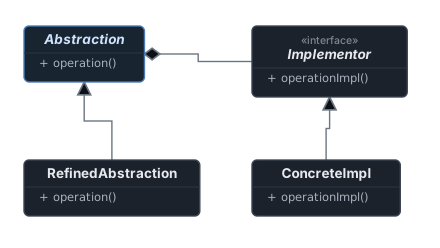
UML class diagram of the Bridge pattern, showing an abstraction hierarchy joined to an implementor hierarchy

Reference · 43 patterns · ~56,000 words

Design Patterns Reference

All twenty-three Gang of Four patterns, the foundations underneath them, the ones that took over after 1995, and a group drawn from Rust on ownership and lifetimes. Every page carries a UML diagram, a worked example, an honest criticisms section, and an argument for why the pattern exists at all. Written to be opinionated rather than encyclopedic: where a pattern is overused, badly named, or already solved by the language, the page says so.
  • UML
  • C#
  • Rust
  • Architecture

Independent research · 2020 to present

MarketAI: sequence learning from first principles

A sequence-learning engine built from first principles, with no pretrained weights and no transformer underneath it, plus the Rust trading terminal that supervises it. The engine learns continuously from surprise rather than in a training phase, reads a signal at several time scales at once, and predicts a set of forward paths instead of a single number. The terminal renders those paths at 144Hz and gives the model one permissioned command surface to act through: the same one a human click uses. The framework is complete and tested; the application renders live market data today, with the trading-enablement layer in progress.

  • Rust
  • wgpu
  • C#
  • GPU
  • Sparse attention
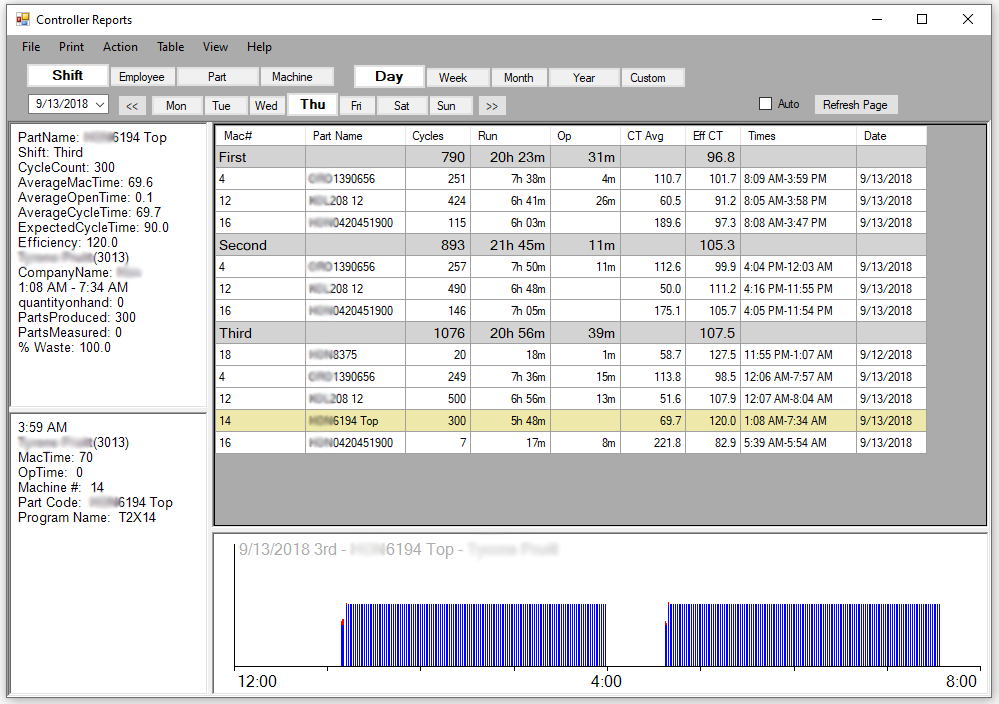
Shift report screen from the Davis Core and Pad monitoring client

1995 to 2020 · Sole engineer

Davis Core and Pad: factory automation and ERP

An embedded controller running the machines on the factory floor, a custom real-time kernel and industrial network stack underneath it, a PostgreSQL database collecting production data, and C# clients turning it into reporting the business ran on.

  • C++
  • C#
  • Assembly
  • PostgreSQL
  • RS-485

Team project

Oahu: virtual classroom

A virtual classroom platform with a scheduling and enrollment model pushed down into the database layer.

  • Angular 7
  • PL/SQL
  • PostgreSQL

For fun

Rayan Blaster: browser games

Small arcade games written straight against the canvas API. No engine, no build step.

  • JavaScript
  • Canvas

What I work on

Areas

Enterprise modernization

Moving mature products onto current runtimes and data access without breaking the behavior their customers depend on. Framework migration, serialization, ORM integration, and the legacy constraints that make the interesting decisions.

  • C#
  • .NET
  • Entity Framework
  • SQL Server

Platform and cross-platform

Getting a product built for one operating system to behave correctly on another, and keeping the build and release path reliable while it happens. Containers, packaging, service hosting, and the differences nobody documented.

  • Linux
  • Windows
  • Docker
  • CI/CD

AI systems

Building a sequence-learning architecture from first principles rather than calling someone else's API, and using current models seriously in engineering: planning, implementation, adversarial review, and structured agent workflows on large changes.

  • Machine learning
  • GPU
  • Agent workflows

Embedded and data systems

Machine control on bare metal and on embedded Windows, including a real-time kernel and a token-ring network stack written because the hardware shipped without either. Schema and stored-procedure design for systems that collect continuously.

  • C++
  • Assembly
  • RTOS
  • PostgreSQL